Sunday, March 24, 2013

Thursday, March 21, 2013
Passover: The Finding Consistency in a World of Diversity
I love Passover. I probably wouldn’t be alone in saying that it remains my favorite Jewish holiday. It has richness, it has beauty and it has heart-wrenching depth.
But that isn’t really why it’s my favorite celebration. It’s because of the amazing diversity of its traditions and its ever changing capacity for expression.
Diversity, you say? If anything, Jewish traditions are rooted in consistency, not diversity. Each year we tell the same story, we eat pretty much the same foods, we symbolize the story of the Jews’ exodus with the same items on the seder plate, we break and hide the matzah the same way.
True, within our individual communities we generally do. And don’t get me wrong: that consistency is what gives value and depth to the Passover holiday. By adopting the traditions that our great-great-grandparents followed, we give them meaning and purpose. We keep them alive, and they in turn, keep our Jewishness alive.
But I still can’t help but be fascinated by the breadth of changes our simple Passover meal has gone through over the years. As Jews have travelled throughout the world, they have tweaked the customs to fit the abundance and limitations of their new homelands. In some cases, they had no choice: in their migration from one culture to another, one climate to the next, the availability of ingredients changed, and so did the recipes and the traditions. Jews who were expelled from Spain during the Inquisition are known to have settled as far away as Mexico (and to have added to the recipe a tropical flavor), Italy (with its interesting addition of citrus and dates), Greece (with pine nuts and sans apple) and parts of Eastern Europe (what is often considered the conventional Ashkenazi charoset, with apples and often missing the citrus of some Sephardic recipes).
Today, this discovery and transformation continues. Each year, as I sweep out the last crumbs of chometz from my cupboards and plan the menu for our seders, I put aside time to log onto the Internet and take a tour around the Jewish universe. I learn about Jewish cultures I’ll probably never visit, I try to imagine what their beginnings were like. I travel to Cuba, where charoset has for years been a humble mixture of matzah, wine and honey – a charoset of the oppressed. What was it like before apples became too expensive to use? Was it something richer, more decadent? And 100 years from now, will that simple mixture of matzah, honey and wine with its own concoction of spices take on a richer, bolder significance and resist change, or will it be transformed by history once again?
I find myself wondering how the last remaining Ethiopian Jews in Gondar will celebrate the holiday this year, knowing that most, if not all, will be in Israel next year. How will their understanding of Jewish customs change, or will some of them remain steadfast, and manage to hold on to their traditions of thousands of years?
And what new communities will emerge next year? This Passover, on the small Portuguese island of Madeira, what is believed to be the first public seder in several hundred years will be taking place. Shavei Israel and a gracious couple from Israel, Danby and Marvin Meital, will be hosting the seder in its well-known resort. Even though the original community no longer exists (there are rumored to be two or three Jewish families living on the island), its ancient Jewish history makes Madeira a fitting place to hold the Passover celebration. In attendance will be people representing many different backgrounds, and possibly, many different Jewish customs. Once again Jews will have a chance to preserve a part of Jewish history by enriching it with their own unique and vibrant understandings of what it means to live and to celebrate the Jewish experience.
Video of Bnei Menashe singing V'hi she'amda at Pesach courtesy of Shavei Israel.
But that isn’t really why it’s my favorite celebration. It’s because of the amazing diversity of its traditions and its ever changing capacity for expression.
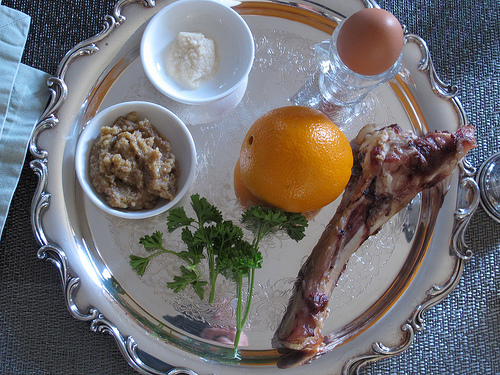 |
| Modern day Ashkenazi seder plate - Eden Hensley Silverstein |
True, within our individual communities we generally do. And don’t get me wrong: that consistency is what gives value and depth to the Passover holiday. By adopting the traditions that our great-great-grandparents followed, we give them meaning and purpose. We keep them alive, and they in turn, keep our Jewishness alive.
But I still can’t help but be fascinated by the breadth of changes our simple Passover meal has gone through over the years. As Jews have travelled throughout the world, they have tweaked the customs to fit the abundance and limitations of their new homelands. In some cases, they had no choice: in their migration from one culture to another, one climate to the next, the availability of ingredients changed, and so did the recipes and the traditions. Jews who were expelled from Spain during the Inquisition are known to have settled as far away as Mexico (and to have added to the recipe a tropical flavor), Italy (with its interesting addition of citrus and dates), Greece (with pine nuts and sans apple) and parts of Eastern Europe (what is often considered the conventional Ashkenazi charoset, with apples and often missing the citrus of some Sephardic recipes).
 |
| Ashkenazi charoset - by Wonderyort |
 |
| Israeli seder for Ethiopian Jews - Jewish Agency for Israel |
And what new communities will emerge next year? This Passover, on the small Portuguese island of Madeira, what is believed to be the first public seder in several hundred years will be taking place. Shavei Israel and a gracious couple from Israel, Danby and Marvin Meital, will be hosting the seder in its well-known resort. Even though the original community no longer exists (there are rumored to be two or three Jewish families living on the island), its ancient Jewish history makes Madeira a fitting place to hold the Passover celebration. In attendance will be people representing many different backgrounds, and possibly, many different Jewish customs. Once again Jews will have a chance to preserve a part of Jewish history by enriching it with their own unique and vibrant understandings of what it means to live and to celebrate the Jewish experience.
 |
| Jewish Quarter, Lisbon, Portugal - Carnaval King 08 |
Video of Bnei Menashe singing V'hi she'amda at Pesach courtesy of Shavei Israel.
Friday, December 14, 2012
In Defiance and Faith: Lighting the Hanukkah Candles in Public

For thousands of years, Jews have been lighting their Hanukkah menorah outside or in front of their windows for the rest of the world to see. Jews take great pride in this public ritual, which sometimes garners criticism from those who are uncomfortable with the public display of an age-old religious tradition. But Hanukkah as a holiday is unique: lighting the menorah in public is a mitzvah. Whereas we bless the candles of most other holidays at dinner table and in the secluded privacy of our homes*, we are specifically directed to publicize the celebration of Hanukkah where others can see.
Hanukkah and Anti-Semitism
Even when there has been evidence of anti-Semitism in the community, Jews have fulfilled this mitzvah. Nor has the ritual changed much over the years. According to Professor Moshe Benovitz, during the Talmudic period the candles were traditionally lit outside one’s home.
Benovitz notes in his paper (to be found in Menachem Mendel's blog post of the same name), Hanukkah: Holiday of Hearth and Home that over the years the tradition was largely moved indoors, particularly in Ashkenazi communities. Benovitz offers several historical theories for this change, including persecution from non-Jewish neighbors. But it is interesting that even after the Shoah (the Holocaust) and the forced relocation of Jews throughout the Diaspora on numerous occasions, Jewish communities have continued to light the chanukiah where the public can witness this testament of faith.

The Orach Chaim, a section of the Shulkhan Arukh, which was compiled in its final form by Rabbi Yosef Karo, serves as an authoritative reference for halachot (laws) concerning Jewish holidays. It provides an exception for public lighting of the candles in times of public distress or difficulty.
“One should place the Chanukah lights at the entrance which is next to the public area, on the outside of the entrance,” says the Orach Chayim. It goes on to explain other options depending upon where the resident lives, including placing the menorah in a window if a public area for lighting is not available.
“However, “(when) in times of danger,” the Orach Chayim notes “… he should place the Hanukkah lights on the table and that is sufficient.”
Lighting the Candles in Times of Danger
So what constitutes “times of danger?” The Orach Chayim qualifies it as living where “there are evil rulers who do not allow one to fulfill the mitzvah.” Does the evidence of unlawful attacks from anti-Semitic groups (e.g. those not sanctioned by any presiding government) constitute times of danger? Should fear of persecution be a guiding principle in such instances? It is worth noting that even in cases in which Jews are being ordered not to celebrate Hanukkah, according to the Orach Chayim, the mitzvah of lighting the Hanukkah candles still takes precedence.
Does the fact that one lives in a democratically ruled country with laws against hate crimes mean that one should never alter this mitzvah?

Or is it because Hanukkah is a way of demonstrating the Jewish community’s resistance toward persecution: a form of defiance as well as a form of public worship?
The Federal Bureau of Investigation’s report on hate crimes (for 2009) states that 72 percent of all hate crimes in the United States were due to the "offender's anti-Jewish bias." ** Yet U.S. and Canadian Jewish communities have developed around the concept that living in a democracy does not require the drastic measures of hiding one’s traditions. More: that their public demonstration helps to educate other communities and promote multiculturalism.
The Hanukkah Menorah and Multiculturalism
Interfaith groups, and Jewish organizations directed toward narrowing the gap between Orthodox, Conservative and Reform Jews have endorsed this view. So has the Hassidic rap artist Matsyahu, who incorporates Jewish symbols, beliefs and traditions into his songs. Being proud of one’s Jewishness can help to reverse stigmatizing, and being willing to share one’s holiday traditions can break down barriers to communication.
As this writer has found, Hanukkah can serve as a powerful bridge between two cultures. Yet the appropriate medium sometimes depends upon the circumstances. In one small town in western Colorado, my family elected to light the candles in a window that did not face the main street because of a history of anti-Semitic behavior by some members of the community. We fulfilled the mitzvah, although cautiously, preserving its view for those who were not threatened by our celebration.
Had it not been for a more fulfilling community experience some years before, our tradition of lighting the candles in front of a public thoroughfare might have been affected by this event. But we had already learned that the Hanukkah menorah carried an important message of support, not only for Jews, but for others as well.

The Festival of Lights
Shortly after my husband’s graduation from university, we moved to a small town in the interior of British Columbia, Canada. Each Hanukkah we placed the lit menorah in the front window of our house. The first year brought carloads of curious neighbors past our front steps. The town in which we lived was primarily First Nations, and many had never seen the chanukiah, much less heard its ancient story. To many, our Jewish tradition reaffirmed our bond with our neighbors, whose ancestors had also endured decades of cultural discrimination and for many years had been prevented from practicing their own traditions, or even speaking their native language. Our new friends were amazed to find that Jews had experienced the same fate many years ago, and were now able to share their holiday traditions in most areas of the world without fear of persecution.
My family and I lit the Hanukkah menorah that year as Jews. By the end of those eight days however, we had come away with an even greater understanding of our connection with those around us.
The ancient rabbis were well versed in the dangers of anti-Semitism, and therefore left an “out” for Jewish families at Hanukkah during times of conflict. But as many Jews have found throughout the years, sharing the defining elements that make one a Jew can also open doors to the common histories that make us human.

*At
Succot we light the Shabbat candles outside in a succah, or booth, but still
with the walls and the assigned setting of a private (though temporary)
domicile.
** These
numbers were down to 1,080 incidents in 2011, reflecting a drop of 495 incidents,
and according to the Anti-Defamation League, the lowest drop in two decades
(Anti-semitic incidents decline in the U.S. in 2011 … Huffington Post 11-03-12)
Wednesday, December 12, 2012
The Multicultural Jew: Finding the True Meaning of Hanukkah
The Multicultural Jew: Finding the True Meaning of Hanukkah: Hanukkah seems like an odd time to contemplate the fate of the Jewish people, yet each year at this time I find myself caught up in questions about our true role in the world.
Monday, October 29, 2012
The Multicultural Jew: Women, Tefillin and Jewish Prayer
The Multicultural Jew: Women, Tefillin and Jewish Prayer: Are tefillin playing more of a role in women’s prayer today?
Tuesday, October 23, 2012
Women, Tefillin and Jewish Prayer
 |
Still, I am struck by how many different ways that people seek, define and establish kavanah – that elusive, ever-Jewish state of mind and heart that allows us to pray. Often summarily explained in English as the intent or “direction of the heart” it has an equally varied association with the Hebrew language.
According to the Ben-Yehuda Hebrew/English dictionary, kavanah translates as intent, purpose, devotion or meaning. It hales from the same Hebrew root as kohnen (כּוֹנֵן), which means to build or to establish; nachonut (נְכוֹנוּת) , preparedness or readiness; and al nachon (אל נָכוֹן) , to the right. Anyone who has lived in Israel knows the expression, Nachon? (נָכוֹן) True?!
The concept of kavanah has been explored by talmudists and kabbalists for centuries. The 12th century scholar Maimonides considered it one of five essential aspects of prayer. It’s as elemental to our spiritual connection as Jews as it is to our cultural definition. A cantor can sing with kavanah, just as one can pray with kavanah. Its lexicon is evidence that spirituality is still at the root of Jewish culture and identity.
 |
| Photo by nagillum |
Yet the path to connecting with our spirituality as Jews is anything but direct or singular – especially these days. As 21st century Jews, we have the liberty to choose how we best relate to Judaism. Women can, and do attend Shabbat services much more frequently and openly than they did 200 years ago and depending upon the synagogue they decide to attend, they can wear a tallits or tefillin. Men can choose not to attend synagogue, or pick a different shul that is more in keeping with their spiritual views. Our understanding of kavanah may still be guided by ancient rabbinical teachings, but we are much more at liberty to interpret their application.
A friend once told me that he felt closest to God high on the pristine, mountainous trails of North America that were far from the infrastructure, people and shuls of modern city life. There he felt free to concentrate, to pray with intention. There have been others that have espoused this preference, as antithetical as it may seem to the precepts of traditional Judaism.
 |
| Photo by שיע.ק |
And yet there are others who are inspired by the closeness of synagogue life.
 As I watched a friend lay tefillin just before Shacharit (morning) minyan one day, I was struck with the intricacy and beauty of the ritual. There was something meditative in the steps that she followed as she circled her left arm seven times with the resuot (straps), moving fluidly down across her hand to form the shin and dalet. As one who has never worn tefillin, it seemed to me that kavanah should be easier to attain with such a contemplative and personal custom. How simplified the inexperienced view!
Later as we spoke, however, I realized that while there was nothing easy about choosing to wear tefillin, my observation wasn’t entirely wrong.
“I feel that they are kind of a physical symbol of being tied to God,” explained Debby Fenson, who serves as the ba’alat tefillah for Congregation Beth Israel in Vancouver, BC Canada and regularly teaches young bar- and bat-mitzvah how to pray with tefillin. “You can’t really connect yourself to God in a physical way, but they are symbolically connecting us to God.”

I later came across a blog that expanded on Debby’s comments, but with a different tack:
The blogger on Barefoot Jewess notes that for her, “Tefillin are a spiritual transformer … They help one directly and intensely connect with G-d; they magnify and sanctify prayer and connection. At the very least, they can provide focus; that is their service.”

“I can’t imagine my life without them,” Barefoot Jewess admitted. “I can still connect with something greater than myself.”
Stories abound of women throughout history who have donned tefillin during prayer. Most of the examples, such as the daughters of Rashi and of King Saul are quickly discounted by critics for lack of historical proof. Yet the fact that a woman’s right to pray with phylacteries has been a subject of vigorous Talmudic debate since at least the 16th century suggests that women throughout history may have taken steps to assume this mitzvah.
And recent discussions like those above suggest that tefillin is playing more of a role, not less, in women’s prayer today. Further, that women seek to fulfill that experience that the Rambam describes as kavanah: the ability to “remove all distracting thoughts and consider that (she) stands in front of the Shechinah.”
Events like the Tefillin Barbie classes and the World Wrap have helped to dispel stigmas about women wearing phylacteries. But so have those individuals who have courageously stepped forward to talk about the real topic: what it meant to them; how it transformed their lives and their sense of “intentional prayer.”
By talking about the experience and relating it to their own spiritual growth, they help demonstrate that the spiritual practice of prayer is personally fulfilling – as well as an ancient Jewish custom. As we have already seen with the use of tallits by women in some Modern Orthodox congregations, open discussions like this have the potential not only to change minds, hearts and opinions, but to bridge ideologies, a concept of peace that lies at the heart of kavanah.

© Photos and text by Jan Lee unless otherwise noted.
Tuesday, August 14, 2012
Poland's Miracle: Jewish Resurgence 70 years Later
 |
| Chachmei Lublin Yeshiva - Tomasz Zugaj |
The numbers of Polish Jews who attended the Chachmei Lublin Yeshiva’s concluding event of the Daf Yomi, (called a Siyum HaShas) may have seemed tiny compared to the many other Jews who had traveled from other parts of the world to witness this event. But as history has pointed out before, miracles often must start small.
Still, the event’s sponsors, which included outreach organizations like Shavei Israel, realized it was an excellent venue in which to educate Polish Jewish descendants about their heritage. A three-day seminar was organized to teach attendees about Poland’s Jewish history and the importance of the Daf Yomi.
 |
| A Page of Talmud - epublicist |
But the creation of this tradition in the early 20th century was actually a fairly forward-thinking concept for its time.
 |
| Rabbi Meir Shapiro, who inspired "Daf Yomi" |
Rabbi Meir Shapiro (or Shapira), who also founded the Chachmei Lublin and saw to its financial success, realized that worldwide Jewish migration was inevitable. So was the growing and at times, destructive disparity between Jewish cultures in the Diaspora. Thus he proposed a plan that could be adopted in any synagogue or yeshiva in the world, and he argued, would help promote Jewish unity. As he explained in his proposal to the Agudath Israel general assembly (London) in 1924*:
How great it is! A Jew travels by boat and takes a tractate of Berachot in his arm. He travels for 15 days from Eretz Israel to America, and each day towards evening he opens the Gemara and studies the daf (Daf Yomi). When he arrives in America, he enters a Beit Midrash in New York and finds Jews studying the very same page that he studied that day, which allows him to happily join their study group. He discusses matters with them and they answer his questions, and the Name of Heaven is glorified and sanctified. Another Jew leaves the United States and travels to Brazil. He returns to the Beit Midrash and finds people immersed in the very page that he studied that day. Can there be a greater unity of hearts than this? (Hevratpinto.org)Almost a century after Shapiro’s revolutionary proposal, religious Jewish life in Poland appears to be experiencing a rebirth that is in some ways, aided by his foresight. Scholars and students from Jewish communities around the world who have taken part in Daf Yomi studies in other countries (all founded on Shapiro’s proposal) have joined together to lend support to Poland’s fledgling religious community.
The Daf Yomi’s resurgence at Chachmei Lublin signifies more than a religious rebirth in Polish Jewish communities. It reaffirms a fact that Jews have known throughout time, and we have the exceptional opportunity to witness in our lifetimes: that no matter how great the tragedy, Jewish culture can survive.

A wedding in Warsaw, Poland, 2012 - Shavei Israel

Poland's newly certified Kosher supervisors (2012) - Shavei Israel
Appreciation is extended to Michael Freund of Shavei Israel, and the authors of On the Main Line blog and Hevratpinto.org for their research on Rabbi Shapiro's work.
* Ed. note: There is some debate as to whether the First General Assembly of the Agudath Israel took place in London in 1923 or 1924. An account in the Jewish Observer (see Hevratpinto.org, above) places the event in 1924.
Friday, July 27, 2012
The Munich Massacre: Translating Tragedy to Faith

 |
| Memorial to the 11 Israelis slain at the Olympics in Munich 1972 - High Contrast |
For many of us who were kids at the time of the Munich Massacre, the slaughter of the 1972 Israeli Olympic contenders by terrorists was an incomprehensible act. The events, which unfolded in painfully slow detail over several days represented a turning point in our lives. For me, it signaled the unexpected birth of my Jewish identity.
No doubt for many young Jews who dreamed of competing at the Olympics one day, the murders provided a dash of cold reality on their futures, a wake up call to the risks that they might be taking by competing in an international competition like the Olympics. In truth, they symbolized risks that to some visceral level, every Jewish competitor recognizes when he or she steps out into the limelight. The Munich terrorist attack however crystallized those fears into reality.
I on the other hand, had never dreamed of Olympic stardom much less an athletics career. Nevertheless, with Munich something changed in me. In my family, events like these were not discussed. They were internalized with an edgy discomfort that made discussions of the most profound tragedies impossible. As I watched the anger on my father’s face and listened to my mother’s frenetic, almost anxious silence during radio reports, I realized a turning point had arrived. Although I could not tell at the time how profoundly it would affect my family, I knew that something in me was changing.
 |
| Casualties transported during Yom Kippur War 1973 - IDF |
“I have half a mind to go to Israel and volunteer."
Looking back, I realize that it was my naivety that both allowed me to appreciate those words as truth, and run with them. My father, a devoutly secular Jew who had devoted his life to clinical research, was a diabetic, almost 50 and in no position to head off to Israel to volunteer during a war.
 |
| Northern Israel, c. 1974 - Dani G. via PikiWiki |
It is interesting that it is others’ shortcomings that often inspire our own spiritual journeys. The inhumanity and cruelty of the terrorists' actions that day in September awakened an awareness in me that would eventually, through many turns, stops and starts, set me on the path to becoming a religious Jew.
Did you experience an event that shaped who you are today? Please share your memories and comments below.

Sunday, July 1, 2012
The Multicultural Jew: Ties that Bind Us to Israel: Music and Stories fro...
The Multicultural Jew: Ties that Bind Us to Israel: Music and Stories fro...: For many of us in the Jewish Diaspora, our relationship with Israel is a complex one. We feel a kinship the contemporary Jewish state, e...
Friday, June 29, 2012
Ties that Bind Us to Israel: Music and Stories from the Heart
For
many of us in the Jewish Diaspora, our relationship with Israel is a
complex one. We feel a kinship the contemporary Jewish state, even
though we don’t live there, and in some cases, never will. We also feel a
commitment to its safety and survival, that could be best described for
many of us as a mitzvah or an historic obligation to protect the Jewish
homeland. The Shoah’s indelible mark has helped to reinforce this sense
of commitment.
It is a testament to that sense of loyalty that North
American parents send their kids to Israel each summer. During the mid
to late 20th century when Israel was still building its commercial
infrastructure, Jewish families sent their children to work on kibbutzim
in exchange for room, board and a few months of Hebrew lessons.
North American Jews bought Israeli bonds to contribute to its economy.
They donated money to Jewish charities that supported immigration to
Israel.
Parents instilled the Yiddish concept of mitzveh to teach their children that it was a good deed to help the fledgling Jewish nation, while reinforcing the Hebrew concept that it was a mitzvah – a Jewish commandment – to stand in support of Jewish heritage. For the teen that travelled to Israel, that trip was an unforgettable rite of passage. For Israel, it was the umbilical cord that assured its connection with the Diaspora and continued support from future generations.
These days we still send our kids to Israel and we still contribute to its economy. But we have found other ways as well to stay in touch with our cultural birthplace, methods that suggest that for today’s generation, it isn’t just obligation or mitzvah that motivates our identity. It’s something more personal and intrinsic to how we see ourselves as Jews here in the Diaspora.
At Yom Ha’atzmaut we fill theatres to hear Israeli singers tell us about their homeland. Performers like the Israeli singer Marina Maximilian Blumin, who paid a visit to Vancouver, Canada on April 25 and has performed across North America, provide us with an up close understanding of what it is like to live on the Jewish frontier, to experience its diversity, and to appreciate musical trends that are not always heard through western media.
Their
music transports us from our common understanding of what it is to be a
Jew in a society where we are a minority, to the singular experience of
living without that distinction.
We attend forums on Israeli political topics and we vocalize our support for Israel in the way we vote, the candidates we elect and the initiatives we inspire. But we also show our support by bolstering less known celebrities, particularly those who help Israel’s first responders.
Singers like Ritasue Charlestein, who has been recognized in Israel for her support of injured service members, have until recently, remain largely unknown in the Diaspora. A member of the Israel Medical Corps who provides support to veterans and active soldiers through songs and acts of compassion, she provides North American Jews with an unusual and much needed glimpse into the challenges, tragedies and triumphs that Israeli soldiers often face on the front line. Her performances have been modest to this point, but continue to gain attention in Jewish communities across the U.S. and Canada.
North American Jews may not use Hebrew in our day-to-day interactions, and some of us may feel self conscious about attending a religious service that is completely in Hebrew, but we don’t have a problem packing a theatre for a night of Israeli music. We wouldn’t think twice about listening to the moving accounts of a first-hand witness interspersed with the Hebrew language and Israeli music.
We listen to Ritasue and Marina not just to
understand our cultural roots, but because in many ways, we feel a
kinship with what they sing and represent. We want to be that
compassionate singer transporting the wounded from their pain. We can
believe for that moment that we’re the one inspiring change, who
transforms distant observers to passionate, compassionate supporters of
Israel. We listen to Ritasue Charlestein’s story of the soldier’s
victory over certain death, and we feel as if we are the ones singing
and appealing for his unexpected recovery.
We watch Marina Maximilian Blumin create her artistry on stage, and find solace and reassurance in its beauty and uplifting power. Israel’s success is confirmed for us each time we find ourselves swept away by the words and songs of its contemporary journey.
For North American Jews, the connection with Israel is much more than an obligation, a mitzvah, or an act of observance. It serves as an affirmation that our lives as Jews, however secular, or however religious in observance, are what define our humanity.
Thanks to Jennifer Houghton and the Jewish Federation of Vancouver for use of the above images.
Appreciation is also extended to Ritasue Charlestein for the opportunity to attend her presentation.
 |
| Ulpan students - by Masa Israel |
Parents instilled the Yiddish concept of mitzveh to teach their children that it was a good deed to help the fledgling Jewish nation, while reinforcing the Hebrew concept that it was a mitzvah – a Jewish commandment – to stand in support of Jewish heritage. For the teen that travelled to Israel, that trip was an unforgettable rite of passage. For Israel, it was the umbilical cord that assured its connection with the Diaspora and continued support from future generations.
These days we still send our kids to Israel and we still contribute to its economy. But we have found other ways as well to stay in touch with our cultural birthplace, methods that suggest that for today’s generation, it isn’t just obligation or mitzvah that motivates our identity. It’s something more personal and intrinsic to how we see ourselves as Jews here in the Diaspora.
 |
| Marina Maximilian Blumin, Yom Ha'atzmaut in Vancouver* |
At Yom Ha’atzmaut we fill theatres to hear Israeli singers tell us about their homeland. Performers like the Israeli singer Marina Maximilian Blumin, who paid a visit to Vancouver, Canada on April 25 and has performed across North America, provide us with an up close understanding of what it is like to live on the Jewish frontier, to experience its diversity, and to appreciate musical trends that are not always heard through western media.
Marina Maximilian Blumin singing "Confession"*
We attend forums on Israeli political topics and we vocalize our support for Israel in the way we vote, the candidates we elect and the initiatives we inspire. But we also show our support by bolstering less known celebrities, particularly those who help Israel’s first responders.
Singers like Ritasue Charlestein, who has been recognized in Israel for her support of injured service members, have until recently, remain largely unknown in the Diaspora. A member of the Israel Medical Corps who provides support to veterans and active soldiers through songs and acts of compassion, she provides North American Jews with an unusual and much needed glimpse into the challenges, tragedies and triumphs that Israeli soldiers often face on the front line. Her performances have been modest to this point, but continue to gain attention in Jewish communities across the U.S. and Canada.
Ritasue Charlestein with Adam
North American Jews may not use Hebrew in our day-to-day interactions, and some of us may feel self conscious about attending a religious service that is completely in Hebrew, but we don’t have a problem packing a theatre for a night of Israeli music. We wouldn’t think twice about listening to the moving accounts of a first-hand witness interspersed with the Hebrew language and Israeli music.
 |
| Marina Maximilian Blumin* |
We watch Marina Maximilian Blumin create her artistry on stage, and find solace and reassurance in its beauty and uplifting power. Israel’s success is confirmed for us each time we find ourselves swept away by the words and songs of its contemporary journey.
For North American Jews, the connection with Israel is much more than an obligation, a mitzvah, or an act of observance. It serves as an affirmation that our lives as Jews, however secular, or however religious in observance, are what define our humanity.
 |
| Israeli Dancers* |
Thanks to Jennifer Houghton and the Jewish Federation of Vancouver for use of the above images.
Appreciation is also extended to Ritasue Charlestein for the opportunity to attend her presentation.
Thursday, May 31, 2012
The Multicultural Jew: Kaddish for the Living
The Multicultural Jew: Kaddish for the Living: I never understood the significance of saying Kaddish for a loved one until I was forced to say it myself ...
Tuesday, May 29, 2012
Kaddish for the Living
 |
| Yom Hazikaron, Ramle - US Embassy, Tel Aviv |
The first time I said Kaddish for my father three years ago, it seemed like an insurmountable challenge. His death had been expected, yet acknowledging it in public required an acceptance that seemed beyond comprehension. Saying those words publicly, before a minyan*, seemed impossible. But by the fifth or sixth day a sense of acceptance had swept over me. My father was gone and I was honoring his life and his significance with these words.
 |
| Man Wrapped in Prayer Shawl (1909) - Leopold Pilichowski |
As I found out during those first few weeks however, finding closure is an individual process. A half hour after watching my father die, I found myself sitting in a mortuary with a family member while he efficiently arranged for my father’s cremation.
In the eyes of some of my family members, cremation was my father’s last wish. It was a final if not efficient form of closure. After all, from their perspective, what more could be wished by a scientist who had devoted his entire career to the clinical explanation of life?
They didn’t know of the discussions my dad and I had about Judaism. They didn’t know that a year before he had died he had asked to borrow the book, To Be A Jew by Hayim Halevy Donin, and had on several occasions engaged me in discussions about Jewish life cycle events. My father, who had been raised secular but had taught me everything I knew about the true meaning of being Jewish had never lost his desire to know and connect with his heritage.
But he still believed that identity was a personal decision, and that it was up to each of his kids to define that question individually. And I suspect that is why to this day, we each claim to understand a distinctive piece of who he was, and what he truly believed. Saying Kaddish for him may not have been what he expected of me, but I think he would have been happy to know I did. Kaddish didn’t just fulfill a religious obligation; in this instance, it gave acknowledgment to the fact that in his own way, he lived his life as a Jew.
My brother’s death last March however, carried a different understanding of the importance of saying Kaddish. An unexpected death catapults one into the present. It is a brutal reminder of the disconnect we have with life, and the fact that even what we believe to be the most consistent can suddenly inexplicably be stripped away from us.
 |
| Man visiting a grave site, Mount St. Olives - Ian W. Scott |
I am convinced that the ancient rabbis understood this. Tradition both binds a community together and mollifies in moments of pain, and there is nothing that quells grief better than consistency of action and the sense that even in the midst of turmoil our ancient traditions still go on.
It was my father’s passing that gave me an understanding of the importance of saying Kaddish, but it was my brother’s death that taught me that Kaddish is truly meant for the living, not for the dead. It honors the dead, but it upholds the living by reaffirming that it is our most personal and sacred traditions that affirm who we are.
 |
| Mourner's Kaddish - prov. by Erika Herzog |
My brother’s death, which occurred three years to the day after my dad’s, will always have an inextricable link to my father’s yahrtzeit. Even though his heart stopped beating only moments before midnight, David wasn’t pronounced dead until the following day. The EMTs spent two hours – well into the early morning of the following day - trying to revive him, to no avail.
And yet, it seems fitting that my brother’s yahrtzeit should fall on a different date than my father’s. Their deaths will remain entwined in memory, but the distinctiveness of who they were will reaffirmed by the simple, though painful act of saying Kaddish two days in a row.
The Mourner’s Prayer, eloquent, stately, but understated, is Judaism’s greatest acknowledgement of the sanctity of life. It gives closure to the irreconcilable and reminds us that memory has a purpose that is best reflected in the accomplishments of the living.
* Conservative and Reform Movements define a minyan (quorum) as a group of at least ten Jewish men or women (e.g., who have reached the age of bar/bat mitzvah). Orthodox Movement define a minyan as at least ten men.
 |
| Six candles for the six million (Pearl Harbor) - US Navy |
Friday, May 25, 2012
Toward A Contemporary Definition of Shavuot
 |
| Shavuot, Gan Shmuel 1936 - PikiWiki |
True, Shavuot is all of these things. It’s history, it’s religious symbolism and it’s our link with our past when Jews relied upon the manual counting of handfuls of wheat at harvest time.
 |
| Wheat Field, Israel - Victor Beruzcov |
But these days we don’t count handfuls of wheat for sale on the global market. In fact, time moves by even smaller increments that reflect the ever changing weight we put on the commerce of our ancestors. The omer has been replaced by the byte, the bushel by the meg. Volume moves in gigabytes and terabytes; relevance is nuanced by what we can exchange in information, not what we can eat in a season.
The proliferation of information is no longer dependent upon runners who can dash across hillsides, and isn’t restricted to the distance of human endurance. Our world is shared in milliseconds, not hours or days.
 |
| Child Refugee - Steve Evans |
So what should be our means today for acknowledging Shavuot? Do changes in our society warrant changes in how we celebrate significant religious events? Are there ways that we can, and do reflect their importance that will help us pass on the meaning of a significant Jewish event?
During the 1960s, ‘70s and ‘80s, the celebration of Shavuot was lost, or at least diminished in many American Jewish homes. In his May 12, 2010 commentary, Forward Magazine's Editor-at-Large, JJ Goldberg offers an explanation for this phenomenon that however, humorous and almost tongue-in-cheek, hits to the heart of Jewish identity.
“The pomp deficit is only a symptom … of Shavuot’s larger problem: its dour message,” says Goldberg.
A message that was, and often still is, perceived as “the handing out of the rulebook, with its bounty of Thou Shalts and Thou Shalt Nots,” not necessarily the uplifting story of a people released from captivity or triumphant in battle (as are Passover and Hanukkah) or the engaging family tradition of experiencing a brightly decorated sukkah in the back yard. For many, Shavuot’s importance lost its relevance as secular Judaism came to the fore in American society in the early ‘60s. Coincidentally, with that loss went the relevance of maintaining Jewish religious traditions that impart who we are.
Today there are many ways to look at the significance of a holiday that gave us the ability to appreciate identity. Yes, there are the classic stories about the Jewish people’s elevated status when it was chosen to carry the Torah, but there are a myriad of contemporary ways to express the gift our ancestors did not have the privilege or human experience to express.
- Since the time of Mount Sinai, we have begun to appreciate the value of a balanced ecology. We have learned that with foresight, we can turn desert landscape into a habitable universe. Over the years we have found ways to teach our children that our heritage and Israel’s ecology are inextricably linked.
- We have converted ancient lessons into medical accomplishments. Israel stands as a technological leader in medicine in areas such as exoskeletal prosthesis for victims of war and terror attacks, cancer research and rehabilitative medicine, all of which underscore mitzvot that preserve and sanctify human life. The Israel Defense Force's Save and Rescue Unit uses what it has learned about saving lives in terrorist attacks to train and aid communities in other parts of the world.
- We have learned that a community isn’t restricted by civic or national borders, and that Jewish history transcends its own lineage in surprising ways that sometimes take hundreds or thousands of years to discover. Communities like the Bnei Menashe in India; Chueta Jews in Mallorca (page 32), Spain; and Iquito Jews in the Amazon reaffirm that the Jewish People aren’t homogeneous in heritage and can be found in every corner of the Earth.

- We have also found ways to connect with and nurture the Jewish spirit in places that were decimated during the Shoah. Places like Poland, Germany, Spain and Russia have reclaimed their Jewish heritage much as did those same countries after pogroms hundreds of years earlier. History may repeat its mistakes, but it has also taught us that the Jewish spirit is strong when supported by others who care.
- We have learned that women have a powerful voice that carries its own measure and its own value, and that Jewish identity matures, strengthens and evolves with each generation that strives to teach the story of Shavuot to the next.
 |
| Child at Shavuot - Mykaul |
Sunday, April 15, 2012
The Multicultural Jew: Challah: Reshaping Our Image of the Quintessential...
The Multicultural Jew: Challah: Reshaping Our Image of the Quintessential...: Challah is a mainstay in the celebration of Jewish traditions. The salty-sweet twist of bread makes its appearance at almost every majo...
Challah: Reshaping Our Image of the Quintessential Jewish Bread
 |
| Shabbos beauty - Roland |
Challah is a mainstay in the celebration of Jewish traditions. The salty-sweet twist of bread makes its appearance at almost every major festivity on the Jewish calendar. Its braided symmetry is meant to be emblematic of the goodness we seek in life. It symbolizes the joy and peace of Shabbat, the continuity of a new year at Rosh Hashanah, and the sweetness that we seek in our life throughout the world. Its braided form holds immense religious symbolism in our observance as Jews and would seem to be an irreplaceable part of every Shabbat meal.
So it is hard to imagine someone turning down a piece of this favourite confection when offered. Harder still to believe, is the fact that there have been millions of Jews throughout history for whom this hand-made delicacy would be nothing short of perilous to eat.
But in fact, a significant number of Jews must abstain from eating challah – or matzo, or hamantaschen for that matter – as the result of a strange and quirky autoimmune disease that wreaks havoc on the body when wheat is ingested.
The affliction is called celiac disease, and its symptoms really don’t have anything to do with wheat per se, but with a protein that is present in wheat, rye, barley and spelt. Ingestion of gluten by someone with celiac disease triggers an autoimmune reaction that can ultimately herald the diagnosis of other diseases, like malnutrition, osteoporosis, and cancer.
 |
| Wheat - Dag Endresen |
Gluten-free advocates often talk about the significant cost and difficulties that this disease can present, but few Jewish authors have centered on what to me, seems an even greater danger: the sense of disconnect that can result from not being able to participate in specific traditions, and the sense of alienation that comes from recognizing that something so intrinsic to our faith is out of bounds for those with celiac disease.
Sure, there are gluten-free (GF) challah recipes these days. In fact, hundreds if not thousands live on the Internet. And there is gluten-free Shemurah oat matzo. There are also support groups, and a staggering number of Jewish cooks with their own personal appreciation of the trials of staying GF. This alone suggests that a significant number of the estimated 3 million celiacs in the United States may be Jews. But even in its best and most ornate form, GF challah is just not the same as the buttery-sweet braided tradition that has been passed down through the ages.
 |
| Rosh Hashanah roundness - Ryan C Boren |
Gluten is also what allows matzo to stay together, but retain its flaky texture, and is an intrinsic part of certain dishes on the Pesach seder table. Without gluten, dishes like chicken soup with matzo balls, gefelte fish and your bubbeh’s fantastic Passover cake are all the harder to make. Judaism is replete with symbols fashioned from gluten’s unique alchemy, and amazingly bereft of kosher options to use in its stead.
 |
| Chickpea GF bread - Artis Rozentals |
Some holiday recipes can survive without gluten, of course. Over the years cooks have discovered curious stand-ins for the protein, like guar gum and xantham gum, that when combined with ingenious mixtures of flours made of bean, vegetable and non-gluten grains can create passable hamantaschen, cakes and cookies. And oat flour, which by itself, is harder to leaven, makes satisfactory matzos.
Sharron Matten, the author of the blog Kosher Every Day and Chicago-based chef notes that rabbis have stipulated that in order for baked bread to be considered challah (and thus observe its Shabbos traditions), it must comprise a “significant amount” of flour from one or more of the five grains. This is an option that is nearly impossible for GF bakers, who often must rely upon large amounts of other ingredients like tapioca, rice flour and potato starch to “lighten” the dough. Matten’s answer to the problem is both ingenious and an example of the extensive brainstorming that Jewish GF bakers must use to remain religiously observant. Her recipe even includes the use of a baking pan that simulates the braided appearance of wheat challah.
Yet the truth is, creative cooking doesn’t override all problems. What does the GF individual do at shul on Friday nights, after Shabbat morning services and bar/bat mitzvahs? Individuals who are GF are unable to eat anything at celebrations if they are unable to tell for sure that the food was prepared with GF needs in mind. Ironically perhaps, the growing availability of non-gebrokts* baked goods at Passover makes the holiday a bit easier for celiacs, but only if there is forethought to labeling the dishes "non-gebrokts" or gluten free.

And it is a problem that is growing. According to the Mayo Clinic, the incidence of celiac disease has risen sharply over the last 60 years. Researchers say the increase is due to improved diagnostic methods, as well as a growing intolerance to gluten in the general population.
Many Jewish communities are already attempting to address this problem by ensuring that there are items on Kiddush tables that are certified gluten free, and that alternative dietary options are available at community events. Still, more that can be done to ensure that Jews who have celiac disease can find the means to stay connected to their communities. They include:
- Organizing educational forums to discuss the halachic challenges associated with a GF diet
- Offering kosher GF cooking/baking classes for Passover and Purim
- Including articles in synagogue newsletters about kosher gluten-free resources
- Establishing a regional “hotline” to help connect individuals with gluten intolerance.
Our traditions sustain and nurture our connections with Judaism and throughout history, have evolved to meet the changing needs of our communities. Perhaps the increasing prevalence of celiac disease will offer just such an inspiration for new traditions and new ways to express the meaning, symbolism and beauty of challah at the Shabbat table.
*Non-gebrokts - (Yiddish) refers to the Orthodox-Ashkenazi tradition of abstaining from eating any product made of matzo that has been combined with liquid (such as matzo balls) during the first seven days of Passover. The Jewish food industry now makes many of its baked products without matzo in recognition of this exceptionally stringent tradition, rendering foods made in this manner gluten-free.
Subscribe to:
Posts (Atom)